Taking people to space was originally done as a political statement of technological dominance. The most expedient route was to take an existing military weapon, the intercontinental ballistic missile, and replace the warhead with a ‘crew capsule’ and a very brave soldier.
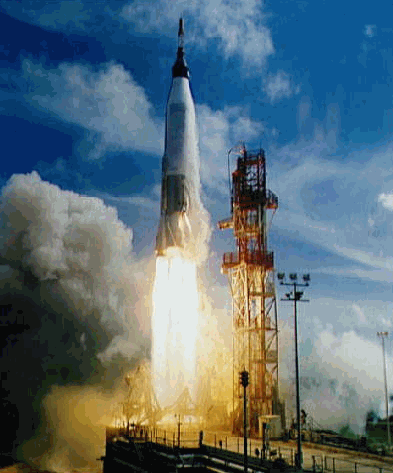
The technology in use today is directly descendent from that approach. Whether there is ‘reuse’ or not – there is a crew capsule on top of a rocket. Only the Space Shuttle and Virgin Galactic’s ‘SpaceShips’ have deviated from the ‘missile’ design.
Due to the desire to lower the cost-per-pound metric – there has been an evolution towards very large vehicles with the associated very large payload capacity. These solutions work if one has 1000’s or even 100,000’s of pounds of stuff to take to an orbital destination. The vehicle, and associated test and launch facilities, are equally LARGE – as well as the supporting staff to make it all happen.
U.S. Legislation (Commercial Space Launch Amendments Act, 2004, and U.S. Commercial Space Launch Competitiveness Act, 2015) gives FAA-AST authority to regulate commercial spaceflight but does not allow the FAA to regulate the safety of people aboard space vehicles. This ‘waiver’ has been granted given the understanding that there will be voluntary Industry Consensus Standards (ICS) developed to guide commercial human space flight. They are under development, and we feel the work we are engaged in now will support these efforts.
 ionspaceexpeditions.com